Family dinner isn’t easy — that’s just a fact of life. But having family dinner? It’s absolutely worth it.
Over the years, we’ve built a meal time routine in our home that keeps family dinner a priority, even on busy days and even with a toddler who brings plenty of chaos to the table.
There’s something grounding about sitting around the table together — talking, eating, and just being present as a family. I know how much we all want that quality time, and I also know how hard it can feel to actually make it happen. Some nights, it can feel as realistic as going to space in a minivan.
Dinner doesn’t need to be perfect. There’s no perfect time, no perfect meal, and no picture-perfect dinner spread that magically makes family dinner work. There are only real people, real meals, real time constraints, real energy levels — and real expectations.
This meal time routine isn’t a one-size-fits-all plan, because that never works for real families. Instead, these are simple practices and a general rhythm that help my family sit down together consistently — and my hope is that they can help your family, too.
This Post Is for You If…
- You care deeply about family dinner, but it feels harder to make happen than you expected.
- You want more connection at the table without adding more pressure to your evenings.
- You’re tired of feeling like family dinner has to be perfect to “count.”
- You have a toddler or young kids and need something realistic, not rigid.
- You want a routine that supports your family — even on busy, messy, or emotionally heavy days.
- You’re looking for a starting point, not another thing to get right.
Why a Meal Time Routine Matters More Than the Menu
If your kids are hungry it matters a little less what’s for dinner and more the fact that there IS dinner. Dinner works best and kids eat more when their bodies are expecting it! You might have noticed that if you eat a meal at the same time everyday you start to be hungry around that time because your body knows whats coming. It works that way for dinner and for our children.
We are able to plan around our dinner instead of planning dinner around our activities. It removes a decision you have to make and the whole day runs a little smoother when you know dinner is coming, when and there is no guess work. That’s why we LOVE our family meal routine.
As calming as a simple anchor like a meal time routine is for you, it is the same for kids. They know when homework has to be done or know when daddy will come home. A consistent dinner time helps them plan and be prepared for the events around and at dinner every day.
Make dinner feel even lighter with our tried and true meals our toddler loves this week 👉 Gluten Free Meal Plans for Families: 30-Minute Dinners That Toddlers Love
The Foundation We Set Before Dinner Even Starts
Protecting Hunger Before Dinner
This is as important for me as it is for my toddler. We try to stop snacking around 2-3 hours before dinner so that we are hungry and WANT dinner when it’s time. I usually plan a well rounded snack for that last snack to tide them over until its dinner time.
This is a key part in my family meal routine with toddlers. Toddler have a hard enough time sitting down to eat, and it’s even harder, maybe impossible, if they aren’t hungry because they are full of snacks.
Our Family’s Daily Dinner Rhythm (What We Repeat)
A Set Dinner Time Creates Predictability
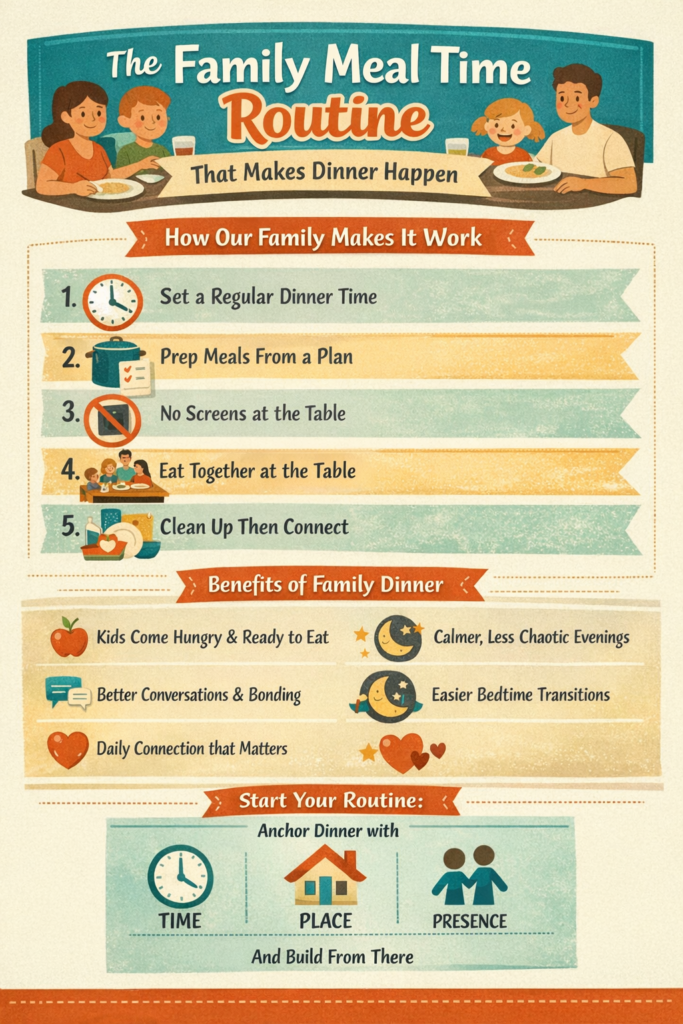
Choosing a dinner time that works for your family is key to this whole process. It might take a little trial and error but once you get it, it makes your family dinner routine flow easily.
The set time tell your body when to get hungry, it helps you plan when to stop snacking and everyone knows when its time to be home.
We chose 6/6:30 for dinner time since that is what we found works for us REALISTICALLY without anyone being under any pressure to act like a NASCAR driver to get dinner done.
Dinner Prep Starts at the Same Time Too
Since you know when dinner is, you know when to start prepping. I would argue this might be more anchoring than dinner time itself, especially if you’re the one cooking. You might choose to start prep at the same time every night or make a note on your meal plan about how long the meal takes to prepare and start then.
This part isn’t to add more rigidity but to take off the mental load of worrying about having dinner done in time.
Meal planning, for us, makes this part MUCH EASIER! I don’t have to carve out more time every night to figure out what I’m cooking or run to the store.
The guesswork is removed with this system in place.
If you’re looking for a way to plan a weeks worth of meal in less than 30 min, check out this post
👉Simple Meal Planning Guide for Busy Families (Gluten Free)
If part of your dinner stress comes from not knowing what to cook or what to keep on hand, I put together a simple grocery list that helps remove some of that daily guesswork. You can grab it here if that would be helpful →
Eating Together With No Screens
Our meal time routine might be completely pointless without this one rule. For us we have found that phones or TV or tablets are just plain distractions. If we have our phones or the TV on we aren’t talking to each other checking in on each other or reaping the benefits from being truly present.
It’s OK if dinner is only 15 or 10 minutes and that’s all the time that you can do . Those short dinners still count and we should always aim for presence over perfection.
Whatever your meal time looks like right now eating together with no screens can be a transition so be patient with yourself and your family and try to get everyone on board so that kin go over smoothly.
In our case since we just have a toddler this is a rule or expectation that we’ve set for ourselves and will continue to set for our family in the future. Prevention is way easier than trying to change a habit that children or teens already have. But it is possible!
Eating at the Same Place — The Table
Eating in the same place every night is an important part of our routine. Especially for our toddler. He knows when he is in his high chair at the table it’s time to eat, not time to play. It also signals to me and my husband that when we are sitting down at the table we don’t use our phones or answer calls.
Where you eat dinner can also turn into a safe space for to share feelings or maybe the hard parts of your day, or just things you’re struggling with as you eat dinner.
It doesn’t have to be a fancy table or a table at all. Maybe you want to eat dinner on the floor. Wherever it is, whatever your family situation looks like, try to be consistent and make it into a safe place.
What Happens After Dinner Matters Too
Clearing the Space Together
After dinner is something that really helps me, as a stay-at-home mom, reduce my overwhelm and mental load. When the counters are cluttered or the table is covered in dirty dishes and who knows what else, my brain feels just as cluttered. I also feel like my family doesn’t have the freedom they need to move around or do things comfortably in those spaces.
So after dinner, we try to clear the table, wipe down the counters, and do the dishes. I’ll be honest — this part of the routine is hard. At the end of a long day, all you want to do is sit on the couch and relax, not tackle the dishes.
I’m on a real journey to focus on small things that reduce the big mental load that builds up when those little tasks are neglected. Just last week, I made dinner cleanup a race for our family. We tried to get everything done in under 15 minutes. I timed us every night for a week — some nights we finished in 5 minutes, other nights it took closer to 20, but it never took longer than that.
That realization has been really motivating for me. Knowing I can give just 10 minutes to this task to help myself feel better tomorrow makes it feel doable. When I think of it as “doing the dishes instead of sitting on the couch,” it feels overwhelming, like it’s going to take forever. But now I know it’s really just 10 minutes — maybe 20 at most.
I’d encourage you to try the same thing if after-dinner cleanup feels overwhelming. Try it for a week — and it doesn’t even have to be seven days in a row. It can be a few nights here and there, whenever you feel up for it. Time yourself. It likely takes far less time than you think, and it’s much easier to give a small, defined amount of time than to carry around the weight of a task that feels huge.
Post-Dinner Family Bonding Time
This has actually become one of my favorite parts of the day. It’s that in-between space — dinner is done, but it’s not quite time for the bedtime routine yet. And in that gap, it’s so easy for the default to be turning on the TV or reaching for a screen instead of spending intentional time together.
For our family — me, my husband, and our toddler — this is often the only window we truly have to be together in the evening.
We use this time to play, go on walks, read, or simply catch up and be present with each other. It doesn’t need to be structured or planned. It’s more of an expectation than a schedule: after dinner, we do something together that promotes family connection. What we do doesn’t really matter — being together is the point.
How We Adjust When the Routine Isn’t Working
This actually happened to me just this week. Something hard and completely out of the blue came up, and naturally, our routine fell apart. I had no emotional, physical, or mental bandwidth to cook a beautiful dinner every night — and definitely not to keep up with our cleanup routine.
So we focused on small things instead, like clearing off the table or simply prioritizing the fact that we put an actual meal on the table at all.
It’s important to remind yourself that when things come up and your routine doesn’t get carried out the way you planned, you are not failing. Sometimes you have the capacity to maintain a full, robust routine — and sometimes you don’t. Routines aren’t there to demand perfection; they’re there to give you structure during hard seasons so you know the bare minimum you can do to set yourself up for some sense of success tomorrow.
This is how you build a family dinner routine. Your entire life doesn’t hinge on executing it perfectly every night. What the routine gives you is clarity — a clear understanding of which small tasks actually reduce your overwhelm and mental load. And when you do have the capacity to return to your full rhythm, you already know exactly where to start and what to do.
That’s the beauty of routines. They give families a starting point, a launching point, and a sense of consistency — even in the middle of busy, messy, and hard seasons.

Benefits of a Consistent Meal Time Routine
The benefits of a consistent mealtime routine are honestly incredible. I want to share a few with you that are backed by research, because they’re not small or insignificant. These outcomes can have a meaningful impact on both you and your children — all from one simple, repeatable habit: family dinner. Research consistently shows that regular family dinner routines are associated with long-term emotional, behavioral, and relational benefits for children.
For me, these benefits are what make pushing through the hard parts of family dinner worth it. They’re the reason building the routine, sticking with it, and making it feel normal in our home is absolutely worth every bit of effort.
- Improved mental and emotional health Children and teens who regularly eat meals with their families show lower rates of depression, anxiety, and emotional distress.
- Lower engagement in risky behaviors Frequent family meals are associated with reduced likelihood of substance use, smoking, and other high-risk behaviors in adolescents.
- Higher self-esteem and resilience Kids who participate in regular family meals tend to have stronger self-esteem and greater emotional resilience.
- Healthier eating habits and better nutrition Families who eat together more often consume more fruits, vegetables, and nutrient-dense foods, and fewer highly processed foods.
- Stronger family connection and communication Family meals provide consistent opportunities for conversation, relationship building, and emotional connection.
- Improved academic and language outcomes Research links regular family meals with better academic performance, stronger vocabulary development, and improved communication skills.
- Reduced risk of disordered eating and unhealthy weight patterns Routine family meals are associated with lower rates of disordered eating behaviors and may support healthier long-term weight outcomes.
- Greater household stability and reduced chaos Mealtime routines create predictability and structure, which can lower overall family stress and support emotional regulation.
Start With the Routine — Let the Rest Follow
You don’t need better recipes. You don’t need stricter rules or a perfectly planned evening. What you really need is a routine your family can return to — something steady, repeatable, and realistic for real life.
When the routine is in place, everything else starts to feel easier. Meals become simpler. Evenings feel calmer. And when life gets busy or hard, you’re not starting from scratch — you already know what matters most and where to begin again.
Start by anchoring dinner with just one thing: a consistent time, a shared place, or intentional presence. Let that be enough for now, and build from there.
FAQ
What if my kids aren’t hungry at dinner?
It’s common for kids to arrive at dinner not feeling hungry, especially if they’ve been snacking throughout the afternoon or evening. Hunger cues work best when meals follow a predictable rhythm. A consistent mealtime routine helps children’s bodies learn when to expect food, which naturally supports appetite at dinner.
In many families, adjusting snack timing — rather than forcing eating at dinner — makes the biggest difference. Dinner still “counts” even if a child eats very little. The goal of family dinner is consistency and connection, not controlling intake at every meal.
How strict should a meal time routine be?
A meal time routine should be consistent, not rigid. Structure works best when it provides predictability while still allowing flexibility for real life. Research and family systems experts consistently emphasize that routines are most effective when they can adapt to changing schedules, energy levels, and seasons of life.
Instead of aiming for perfection, families benefit from identifying a few anchor points — such as a general dinner time, a shared eating space, or screen-free meals — and returning to those anchors whenever possible.
Does family dinner still count if it’s short?
Yes. Family dinner still counts even if it’s brief. Studies on family meals consistently show that the benefits come from regular shared time and interaction, not from how long the meal lasts or how much food is eaten.
A 10-minute dinner where family members sit together, eat, and connect can be just as meaningful as a longer meal. Consistency over time matters far more than duration on any single night.
How do you do this with toddlers?
Family dinner routines with toddlers work best when expectations are simple and age-appropriate. Toddlers benefit from predictable schedules, familiar foods, and short mealtimes. It’s normal for toddlers to eat inconsistently, leave the table early, or need movement breaks.
Rather than focusing on how much a toddler eats, families often see better results by focusing on routine — eating together at a regular time and place — and allowing toddlers to participate at their developmental level. Over time, this predictability supports both emotional regulation and eating skills.